June 2026 Highlight Reel
Every week, Creation Today brings viewers the latest discussions in creation science, apologetics, theology, archaeology, and culture. Over the first six months of 2026, we covered dozens of topics with some of the world’s leading creation scientists, researchers, pastors, and Christian thinkers.
 This week, Eric Hovind was joined by Creation Today’s Social Media Manager, Rachel Mims, for a special six-month highlight reel. Together they looked back at some of the biggest moments, strongest arguments, and most memorable conversations from the first half of the year.
But there was a twist involved.
As they revisited clips from previous shows and sorted through thousands of comments left by skeptics online, they decided to play a game called “Atheist Bingo.”
 The concept was simple. Every time a common atheist talking point appeared in the comments, they marked off a square on the bingo card. Before long, familiar phrases began showing up exactly as expected. “No Evidence for God.” “Christians Are Anti-Science.” “God of the Gaps.” “Peer Review.” “The Bible Is a Myth.” “You Deny the Facts.” “Death Is Natural.”
One of the first clips revisited came from our conversation with geologist Dr. Andrew Snelling from our show Top 10 Evolution Arguments Debunked – Geology Edition (CreationToday.org/470)
 Dr. Snelling discussed remarkable geological formations containing tree trunks that extend vertically through multiple sedimentary layers and coal seams. These trees were not growing where they are found today. They have no roots attached and belong to species that do not grow in swamps. Yet they pass through rock layers that, according to conventional interpretations, represent vast periods of time.
Dr. Snelling posed a straightforward question: How could those tree trunks survive long enough for all of those layers to slowly accumulate around them? The wood should have decayed long before the surrounding sediments were deposited.
For Eric, this was one of those examples that anyone can understand. The evidence is right there in front of you. If one tree extends through layers supposedly separated by thousands or millions of years, that deserves an explanation.
What surprised Eric and Rachel was not the evidence itself, but the responses.
One commenter simply wrote, “Please stop lying for money.”
Another responded, “Gobbledegook. Just created lies.”
Neither addressed the geological evidence. Instead of discussing the tree trunks or the sedimentary layers, they attacked the person presenting the argument.
The same thing happened when commenters began questioning Dr. Snelling’s education. One suggested his geology degree probably came from a seminary. Another mocked his intelligence entirely.
The irony, of course, is that Dr. Snelling holds multiple geology degrees, including a doctorate from the University of Sydney, and has spent decades studying the very rocks being discussed.
As Eric pointed out, many critics never interact with the actual evidence. Instead, they attack credentials, motives, or intelligence while leaving the argument itself untouched.
The next stop on the highlight reel was one of the most fascinating scientific discussions of the year: the origin of life.
 Revisiting our interview with Dr. Paul Nelson, Finding The First Cell
(CreationToday.org/472), Eric and Rachel discussed the enormous gap between chemistry and biology.
Darwin once speculated that life may have arisen in a warm little pond containing a few chemicals and an energy source. Modern biology has revealed something far more complicated. Even the simplest living cell contains staggering levels of complexity.
According to Dr. Nelson, the distance between what unguided chemistry can produce and what living cells actually require has not gotten smaller. It has gotten larger.
Many commenters quickly objected that abiogenesis is not evolution.
Eric agreed that the two subjects are technically different, but pointed out that every worldview must explain how life got here in the first place. A theory describing how life diversified still depends on life existing before diversification can occur.
As Eric observed during the discussion, naturalistic worldviews often accuse Christians of invoking God whenever there is a gap in knowledge. Yet when it comes to the origin of life, the problem is frequently pushed backward rather than solved.
Researchers continue investing enormous amounts of intelligence, effort, funding, and laboratory resources into creating life from non-life. Even if such an experiment were successful, it would still involve intelligent scientists carefully directing every step of the process using pre-existing materials. Ironically, it would demonstrate the necessity of intelligence rather than eliminate it.
Another memorable segment featured one of our campus outreach conversations with evangelist John Harris from Living Waters UK.
Speaking with a university student, Harris observed that many people claim to follow evidence wherever it leads. Yet when evidence challenges deeply held assumptions, it is often rejected before being seriously considered.
He encouraged the student to recognize that rejecting evolution would not diminish her value. If humans are created in God’s image, then they possess intrinsic worth, purpose, and dignity that cannot be explained by a purely naturalistic worldview.
One atheist commenter responded by claiming that atheists are not making any positive claim at all. According to him, atheism is simply a lack of belief.
Eric challenged that position.
Using an illustration often shared by Ray Comfort, he explained that claiming there is no gold anywhere in China would require complete knowledge of China. Likewise, claiming there is no God would require complete knowledge of reality itself.
For that reason, Eric argued that many modern atheists have shifted toward agnosticism while continuing to use the label atheist. Rather than defending the claim that God does not exist, they redefine atheism as a lack of belief and attempt to place the entire burden of proof on Christians.
And that was only a small portion of the show.
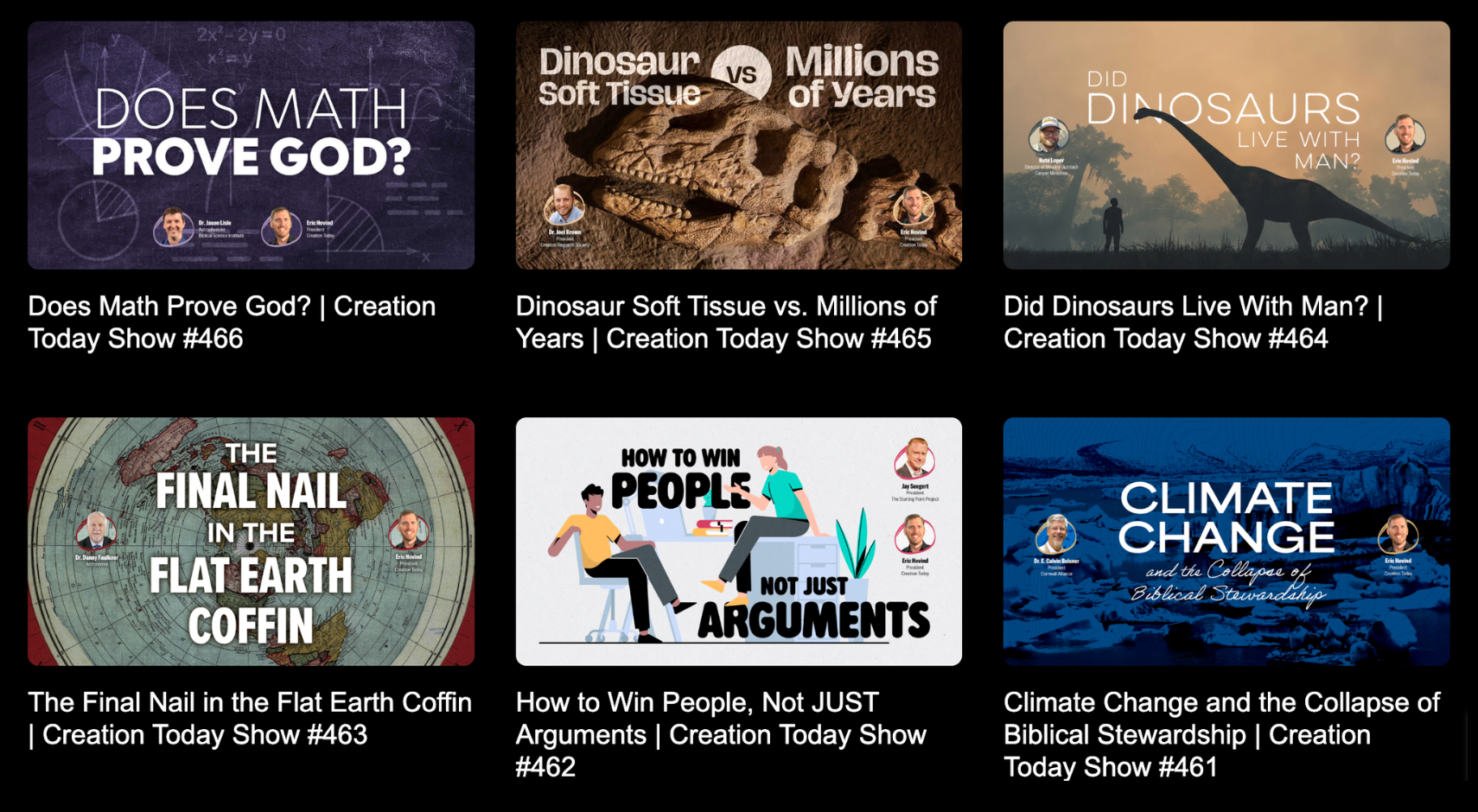 The six-month highlight reel also revisited discussions on climate change with Dr. Calvin Beisner, dinosaur soft tissue with Dr. Joel Brown, death before the Fall with Dr. Marcus Ross, mathematics and God’s nature with Dr. Jason Lisle, biblical archaeology, peer review, flat earth, Genesis lifespans, and many other memorable moments from the first half of 2026.
Most importantly, the episode highlighted just how often the same objections appear regardless of the topic being discussed.
Whether the conversation involved geology, biology, theology, mathematics, archaeology, or philosophy, the same handful of talking points surfaced again and again.
If you’ve ever wondered how to respond to common atheist objections, if you’ve missed some of the best conversations from the first six months of 2026, or if you simply want to enjoy one of the most entertaining recap episodes we’ve ever done, you’ll definitely want to watch the full Highlight Reel.
Watch Creation Today Show: