Did Dinosaurs Live With Man?
That was the central question in our most recent Creation Today Show with Eric Hovind and special guest Nate Loper.
 Nate has traveled the world studying this very topic, not just in theory, but on location. From the halls of ancient Egypt to museums, cathedrals, and universities, he has examined pieces of evidence long held up by creationists as proof that dinosaurs lived alongside man.
But that raises the obvious question.
How could that be true?
After all, the secular world, built on an evolutionary timeline, insists dinosaurs died out 65 million years ago, long before humans ever existed. So who’s right?
As creationists, we must begin where truth begins, with Scripture.
Genesis makes it clear that God created all land-dwelling animals on Day 6, along with man. That would include dinosaurs. There is no separation in the biblical timeline.
Scripture even gives us direct descriptions.
In Job 40, God describes Behemoth, a massive land creature, the “chief of His ways,” with a tail like a cedar tree and incredibly strong bones. This is not a hippo or an elephant. The description points to something far larger. According to Nate, the closest known match is a sauropod dinosaur.
Then in Job 41, we read about Leviathan, a powerful sea creature capable of terrifying ships. While harder to identify precisely, it fits well with the idea of a massive marine reptile, possibly something like a mosasaur.
It’s also important to remember that the word “dinosaur” wasn’t invented until 1841. Before that, these creatures were commonly referred to as dragons, a term the Bible itself uses.
So what about evidence outside of Scripture?
There is strong evidence worth considering:
✓ Marco Polo recorded accounts of large reptilian creatures pulling carts in ancient China
✓ Ancient Peruvian pottery and burial masks depict dragon-like animals
✓ Dragons appear across cultures worldwide, even on national symbols like the Welsh flag
✓ The carvings at Carlisle Cathedral show what appear to be two long-necked creatures intertwined, resembling sauropods
✓ Historical accounts like St. George slaying a dragon
✓ The story of Beowulf, describing a massive reptilian creature

And these are only a small fraction of what exists.
But this is where the conversation becomes critical.
Not all evidence is good evidence.
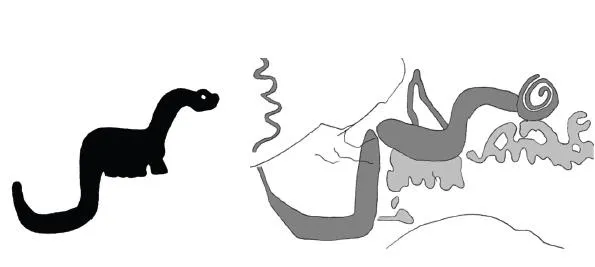
For example, the supposed sauropod carving at Natural Bridges Monument in Utah. When viewed in isolation, it looks convincing. Butwhen examined in full context, the entire panel is actually a map of the surrounding landscape. What appears to be a dinosaur matches the topography. This is not a dinosaur carving, and we should be willing to let that claim go.
 The Ica stones in Peru are another example. While many depict humans and dinosaurs together, they lack proper documentation. Some were admitted to be carved for the tourist trade, and the markings appear too fresh to be ancient. Is it possible that out of the many thousands, a few may be authentic? We can’t say for sure.
And this matters.
Holding onto weak or questionable evidence does more harm than good. It makes it seem like we need it to support what we believe, when we don’t.
So what did we conclude from this discussion?
Nate helped answer three key questions:
Does letting go of bad evidence weaken our faith? No.
Do we need artifacts to prove dinosaurs lived with man? No.
Does rejecting weak evidence mean dinosaurs didn’t live with man?
Absolutely not.
In fact, it does the opposite.
It shows integrity. It shows that we are committed to truth, not just winning an argument. Our foundation is Scripture, and the evidence that aligns with it strengthens that foundation, it doesn’t create it.
This was an incredibly insightful and important discussion for anyone wondering what evidence is truly worth using, what should be set aside, and whether we can trust Scripture as our ultimate Authority.
You won’t want to miss this conversation.
Watch Creation Today Show: