Egypt Remembers Noah And The Flood
 We just finished an incredible, information-packed episode with Eric Hovind and researcher Gavin Cox, and it is one of those conversations that reshapes how you see the ancient world. Gavin has spent years studying Egyptian texts, temple reliefs, king lists, funerary writings, and religious symbolism, asking a question few scholars are willing to entertain seriously: what if ancient Egypt did not invent flood myths at all, but instead preserved distorted memories of a real, world-altering event? In our previous conversation, we explored Adam and Eve in Ancient Egypt, where we examined how Egyptian creation accounts, name pairings, and serpent imagery closely mirror the opening chapters of Genesis. That discussion laid critical groundwork. In this follow-up episode, we move forward in history to Noah and the Flood, and the evidence only becomes more striking.
From the biblical perspective, Noah is never treated as a symbolic or mythological figure. Jesus Himself spoke of Noah as a real man and the Flood as a real event when He said, “As the days of Noah were, so shall also the coming of the Son of man be… they knew not until the flood came, and took them all away” in Matthew 24. Luke records Jesus saying the same thing: “As it was in thedays of Noah, so shall it be also in the days of the Son of man. They did eat, they drank, they married wives… until the day that Noah entered into the ark, and the flood came, and destroyed them all.” Luke then places Noah directly in Jesus’ genealogy alongside Adam, Abraham, and David, listing him as a real ancestor in Luke 3. The apostle Peter follows the same pattern, referring to “the days of Noah, while the ark was a preparing, wherein few, that is, eight souls were saved by water,” and later calling Noah “a preacher of righteousness” when God “brought in the flood upon the world of the ungodly.” Scripture makes no distinction between “historical” people and “mythical” people. Noah belongs to the same historical framework as everyone else.
 Genesis itself spans roughly 2,198 years of history, and when you trace the patriarchs carefully, something remarkable emerges. From Adam to Noah, and from Noah to Abraham, the patriarchs overlap for approximately 1,656 years. This means these men lived contemporaneously. They did not rely on distant oral legends passed down like a game of telephone. They handed history down directly, living side by side across generations. And those Flood patriarchs did not vanish after the waters receded.
Genesis tells us exactly where their descendants settled. “The sons of Ham; Cush, and Mizraim, and Phut, and Canaan.” Mizraim is Egypt. In fact, the Hebrew Bible refers to Egypt as Mizraim hundreds of times and repeatedly calls it “the land of Ham.” The Psalms say, “Israel also came into Egypt; and Jacob sojourned in the land of Ham,” and again, “Wondrous works in the land of Ham.” If Noah’s descendants carried pre-Flood knowledge into the post-Flood world, Egypt should be one of the first places where that memory would survive. And that is exactly what we find.
Egyptian religious tradition speaks of a group known as the Ogdoad, eight primeval figures associated with floodwaters, chaos, and the rebirth of the world. These eight are consistently depicted as four male-female pairs and are often shown with snake-headed males and frog-headed females, animals closely tied to water and inundation. They are not treated as abstract concepts but as ancient fathers, culture-bringers, and restorers of order. There is even a City of the Eight and temples dedicated to them. Why eight? Because Genesis tells us eight people survived the Flood.
Egyptian texts reinforce this memory repeatedly. The Coffin Texts openly declare, “I made a great flood… I forbade them to do wrong, but their hearts disobeyed what I had said.” The Egyptian Book of the Dead, used by everyday people who could afford to place a papyrus in their tombs, continues this theme. One well-known passage states, “I shall indeed destroy all that I have made, and this land shall turn into Nun, as floodwater, as its original condition.” Nun is the primordial floodwater from which land emerges again.
This same idea appears visually throughout Egypt. The pyramids themselves symbolize land rising out of the waters. The benben stone, a pyramid-shaped mound associated with creation and renewal, represents the first dry land to appear after the waters receded. That imagery closely parallels Genesis, where God says, “Let the waters under the heaven be gathered together unto one place, and let the dry land appear,” and later, after the Flood, “the ark rested upon the mountains of Ararat… and the waters continued to abate… and the tops of the mountains were seen.”
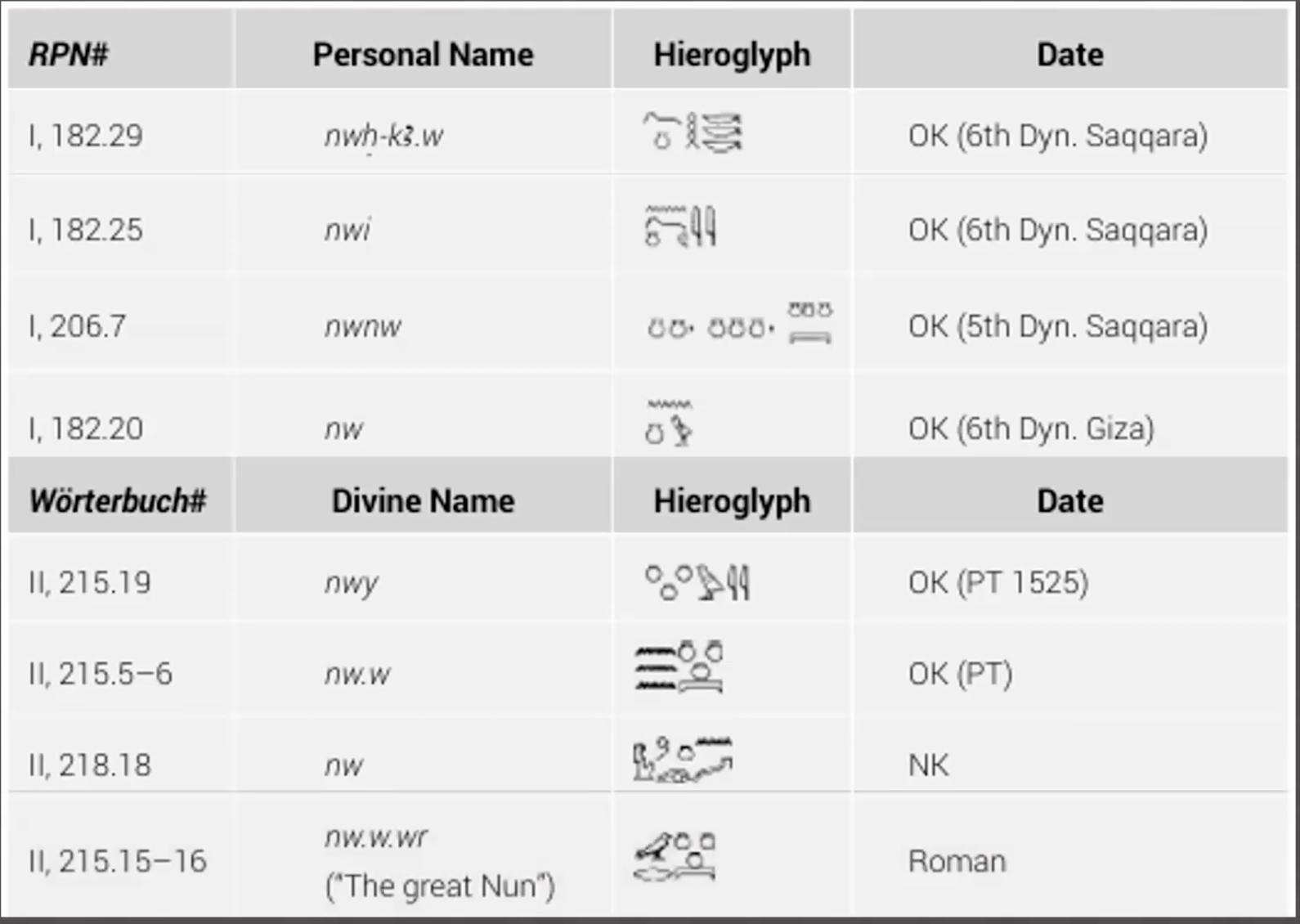 The names of the Ogdoad figures are equally arresting. Nu and Naunet, Amun and Amunet, Kek and Keket, Heh and Hauhet appear repeatedly in Egyptian texts. When examined linguistically, these names align closely with Noah and his sons Shem, Ham, and Japheth, including wordplay tied to water, rest, and renewal. Genesis itself plays on Noah’s name when it says, llk Egyptian texts do the same thing. Nu is associated with primordial waters, while Hebrew writing about Noah is saturated with water imagery. Even the dove Noah sends from the ark appears in Egyptian texts using related terms for dove and pigeon. These are not random coincidences. They are consistent thematic fingerprints.
Genesis tells us Shem, Ham, and Japheth lived into the time of Abraham. They outlived entire civilizations. They carried pre-Flood knowledge into a reset world and helped restart civilization. Egypt remembers them not merely as ancestors but as deified founders. Tombs from the 26th Dynasty, papyri from the 19th and 21st Dynasties, and even imagery in King Tut’s funerary chapel reference a great flood and a group of eight. At Medinet Habu, inscriptions speak of “the noble fathers who brought into being the beginning… when the land was in utter darkness and every existing thing was flooded.” That is not abstract mythology. That is memory.
So why has this evidence been overlooked? Gavin explains that modern scholarship operates within a materialist framework that assumes Genesis borrowed flood stories from Babylon during the exile. This assumption, rooted in the Documentary Hypothesis, leads scholars to dismiss Egypt outright. But when the actual data is examined, the direction of influence reverses. The Atrahasis Epic, the Epic of Gilgamesh, the Sumerian King List, and Egyptian texts all preserve flood accounts centered on a single figurehead and a restart of civilization. Genesis does not borrow from them. They echo Genesis.
Egypt does not contradict Noah. Egypt remembers Noah. The ancient world preserves his memory in names, temples, texts, and stone. The Flood is not an invention. It is the most remembered event in ancient history.
If you want to see how Scripture, archaeology, and ancient texts converge in a powerful and unexpected way, you need to watch this episode. Egypt does not stand against the Bible. It stands as a witness to it.
Watch Creation Today Show: