Excavating Biblical History
History does not whisper. It testifies.
 For years, critics have treated Scripture like a relic of imagination, something detached from the real world of stone, soil, and cities. But as our recent conversation with Dr. Scott Stripling made unmistakably clear, the ground keeps telling a different story. Archaeology is not guesswork. It is the moment a shovel cuts into the earth and exposes something that has been waiting there all along. Names, places, and events make themselves known. Not theory or speculation, but physical remains that demand to be reckoned with. Again and again, those remains align with the biblical record in ways critics once said were impossible.
Take King David for example. Once dismissed as legend, now confirmed by four known inscriptions outside the Bible. Even secular scholars have had to concede his existence. They may try to shrink him down to a minor tribal leader, but they can no longer deny that David existed. Another example is the Merneptah Stele that places Israel in history early, exactly where Scripture says it should be. And yet the debate continues, not because the evidence is absent, but because it pushes back against a worldview that resists the authority of God’s Word.
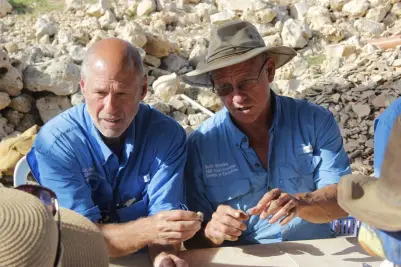 Dr. Stripling walked through site after site where this tension is unfolding. Jericho is a perfect example. Critics long pointed to the wrong layer of the city and declared there was no evidence for Joshua’s conquest. But when the focus shifts to the correct city level, the evidence lines up remarkably well with the biblical account. The issue was never the absence of evidence. It was a misinterpretation. The same is true for nomadic evidence in the wilderness. Skeptics ask where the millions of Israelites are in the archaeological record, but nomadic people do not leave behind cities and monuments. Even so, there are traces. Subtle, but real. Enough to confirm movement, presence, and patterns consistent with Scripture.
Then there is Mount Ebal. A site tied directly to the covenant renewal described in Joshua. There, in a dump pile, buried and overlooked, a folded lead tablet was discovered. Inside, an inscription invoking the name Yahweh. The script dates to the very period of Joshua. This is not centuries removed. This is early, direct, and powerful. It is exactly the kind of find that critics said should not exist.
And the discoveries do not stop in the Old Testament. Near Megiddo, what is now recognized as the earliest known church building was uncovered. Inside, an inscription referring to Jesus Christ as God. Early. Clear. Unmistakable. For years, many claimed there were no formal Christian worship spaces before later church councils. That claim has now been buried under the weight of real evidence. The early believers were not vague or uncertain. They were declaring the identity of Christ boldly, and they were doing it far earlier than skeptics were willing to admit.
Even methodology itself has been challenged. One secular Israeli archaeologist, once mocked for taking the Bible seriously as a historical source, used it to guide her excavation in Jerusalem. She was ridiculed for it. Yet her work led to the identification of what is now widely recognized as the palace of David. The very text critics dismissed became the roadmap to discovery. That is not coincidence. That is confirmation.
Here is the reality. Only a small fraction of the biblical lands has been excavated. Around six percent. Think about that. Critics build sweeping conclusions on a tiny sample of the available evidence, then declare the rest of the record silent. But the silence is not from history. It is from unturned ground.
This matters because it exposes the real issue. The debate is not about whether evidence exists. It is about how that evidence is interpreted. Every artifact, every inscription, every wall, every tablet must be understood through a lens. And when that lens is rooted in human assumptions instead of God’s Word, the conclusions will always drift.
 Our conversation with Dr. Stripling was not just about archaeology. It is about authority. It is about whether Scripture is treated as a reliable record of real events or dismissed until forced back into the conversation by undeniable discoveries.
The rocks are speaking. The question is whether people are willing to listen.
If you have not watched the full discussion yet, you need to. For your own truth and knowledge about God’s Word. This is where the ground meets the Word. This is where history refuses to stay buried. And this is where the truth stands, not because it needs defending, but because it cannot be erased.
Watch Creation Today Show: