Genesis Lifespans – The Detail that Destroys Deep Time
Did Adam really live 930 years? Did Noah truly live to 950? Did Seth actually live to 912 years?
 When Christians read the genealogies of Genesis 5 through 11, those are the questions that immediately come to mind. Most Christians today either read quickly past those numbers or assume they must contain some hidden symbolic meaning because modern culture has already declared such lifespans impossible. We are constantly told that science has disproven the biblical timeline, that Genesis cannot be read as real history, and that Christians need to reinterpret the text to fit millions and billions of years. But what if the real problem is not the text itself, but the assumptions we are bringing to it?
That is exactly why the recent conversation between Eric Hovind and Henry B. Smith Jr. was so important. Henry B. Smith Jr., who serves with Associates for Biblical Research and has spent years researching biblical chronology and Genesis genealogies, carefully walked viewers through the text itself and delivered a powerful and undeniable case that these ages cannot simply be dismissed as symbolic, exaggerated, or mythological without destroying the structure of Genesis itself. This was not merely a discussion about “people living a long time.” It was a direct challenge to the growing old earth reinterpretations that are spreading through the modern church and slowly eroding confidence in the plain meaning of Scripture.
 As the conversation unfolded, we learned how the ages of Adam, Noah, Abraham, Isaac, Jacob, and the patriarchs are woven directly into births, deaths, famines, covenants, journeys, genealogies, and historical events throughout Genesis itself. Near the end of Genesis, Jacob personally tells Pharaoh that he is 130 years old and that his years have been fewer than those of his fathers before him. Then Genesis records that Jacob lived another 17 years and died at 147. Henry pointed out how impossible it becomes to honestly claim these numbers are symbolic when Jacob himself naturally speaks about his literal age within the narrative. The same issue appears with Abraham. Abraham questions how a man of his age could still have a son. Sarah’s age is recorded precisely. Isaac’s birth is tied directly to Abraham being 100 years old. Ishmael is circumcised at 13 while Abraham is 99. Then Genesis concludes Abraham’s life at exactly 175 years old. The narrative continually builds around these ages in ways that make symbolic reinterpretations collapse once you carefully follow the flow of the text.
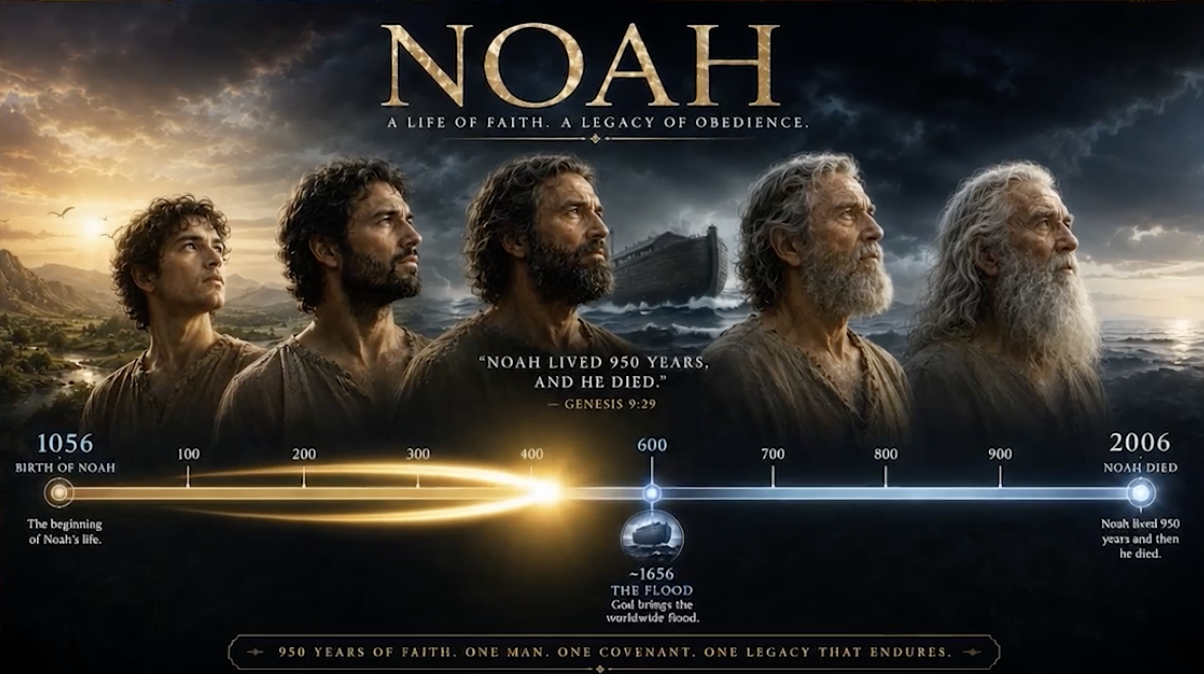
Henry repeatedly emphasized that these numbers are not isolated verses disconnected from the rest of Scripture. They are tightly integrated into the chronology of Genesis and interconnected with the Flood narrative, the post-Flood genealogies, the nations after Babel, and the lineage leading directly to Jesus Christ Himself. The genealogies are directly connected to the global Flood, the Tower of Babel, the nations of the earth, the promises to Abraham, the history of Israel, and ultimately the genealogy of Jesus Christ Himself. They form the chronological backbone of biblical history itself. Genesis 11 says Arphaxad was born two years after the Flood. Noah’s age is tied directly to the timing of the Flood itself by exact years, months, and days.
Jared was 162 years old when Enoch was born and then lived many years afterward. These are chronological anchors embedded throughout the narrative. Henry explained that once you begin turning these ages into symbols, the entire structure begins unraveling. Because if Abraham’s 175 years are symbolic, then what do we do with the years connected to Isaac’s birth? Or Jacob’s speech before Pharaoh? Or the “two years after the Flood” marker tied directly to Arphaxad? The chronology interlocks in ways that simply cannot be escaped.
 One of the strongest parts of the conversation was Henry’s direct confrontation of the various old-earth interpretations Christians are being encouraged to accept today. Some scholars claim the ages are symbolic. Others argue they were inflated to honor patriarchs or borrowed from mythology. William Lane Craig has promoted a “mytho-history” approach to Genesis and treats the patriarchal lifespans as mythological in nature. Hugh Ross and other old-earth proponents attempt to place Adam deep into human history while harmonizing Genesis with evolutionary timelines and ancient hominid populations.
But as Henry powerfully demonstrated throughout the discussion, these views do not arise naturally from the biblical text. They are imposed onto the text because modern academia has already declared long lifespans and a young earth impossible. Christians need to honestly ask themselves whether they are allowing Scripture to speak for itself or filtering it through evolutionary assumptions first.

Because once you begin treating these ages symbolically, the problems spread everywhere. If Noah’s years are symbolic, then what do we do with the exact timing of the Flood down to the months and days? If Genesis 5 and 11 contain huge hidden gaps, then why does the text repeatedly connect births, years lived afterward, and generational chronology so tightly together? Henry explained that the syntax itself does not allow for the hidden ages or missing timelines many old-earth interpretations require. The only consistent way to understand the chronology is to read the years as real years exactly the way the text presents them.
The conversation also exposed the serious theological consequences that follow once Genesis is reshaped around deep time. Some old-earth views place Adam hundreds of thousands of years into human history while also maintaining that death, suffering, disease, and extinction existed long before Adam sinned. Others attempt to merge Adam’s descendants with pre-existing hominid populations. But as Henry and Eric discussed, these views create enormous tension with the biblical teaching that death entered through sin and that Adam stands at the beginning of humanity’s history. Once death exists before sin, the foundation underneath the Gospel itself begins to crack.
And that is why this conversation matters so much.
What Henry B. Smith Jr. presented was not a weak or secondary issue. It was a powerful defense of the clarity and authority of Scripture against old-earth compromise and evolutionary reinterpretation. The genealogies of Genesis are not meaningless filler text. They are chronological history given by God for a reason. And if Christians continue surrendering the plain meaning of Genesis to satisfy modern theories about the past, the unraveling will not stop there.
This was an incredibly important conversation that every Christian wrestling with Genesis, biblical chronology, evolution, old earth compromise, and the authority of Scripture needs to watch. Because ultimately, this is not just about ancient numbers. It is about whether God has spoken clearly, whether His Word can be trusted, and whether the church will stand on Scripture or continue reshaping it to fit the spirit of the age.